

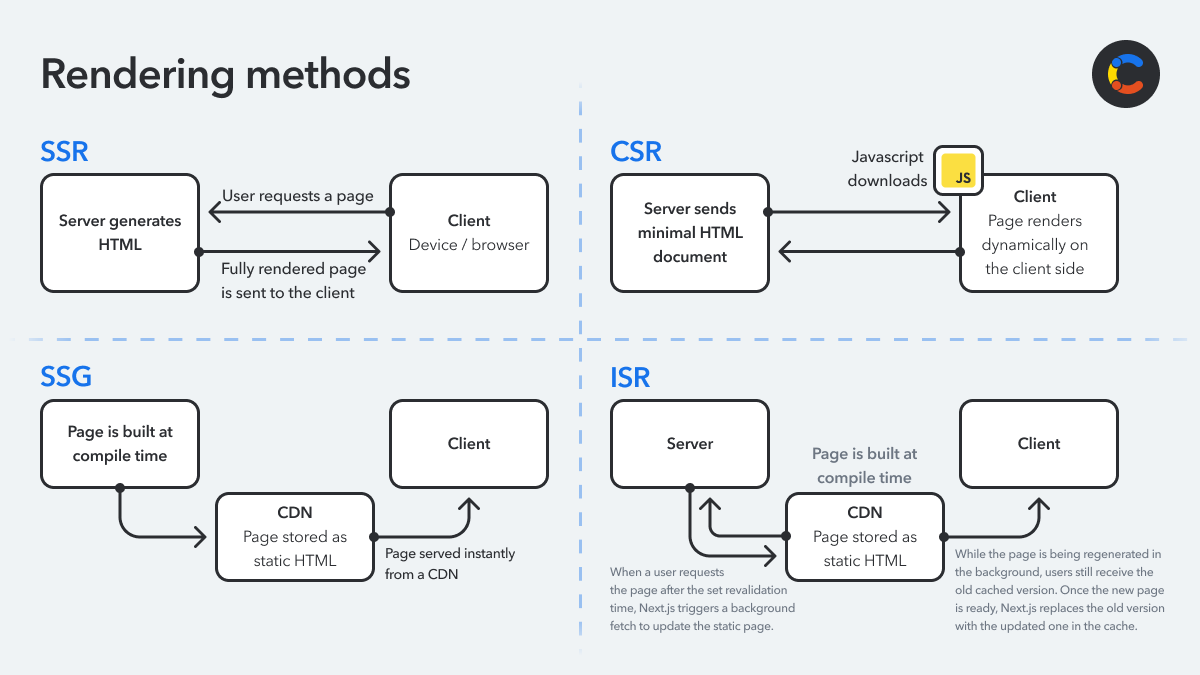
“SSR” isn’t one thing anymore. Between React Server Components (RSC), streaming, pre-rendering, and smart caching, your choice of framework shapes not just how pages render but how your team thinks about routing, data, and deployment. Two of the most prominent options today are React Router v7 (the evolution of Remix) and Next.js. Both do server-side work brilliantly—yet they approach the problem from different angles that matter for architecture, performance, and Developer Experience (DX).
What actually changed with Remix?
In 2024, the Remix team announced that they were merging the framework back into React Router; what would have been Remix v3 would have shipped as React Router v7. For existing Remix apps, the practical upshot is mostly import changes and a codemod-assisted upgrade path; the philosophy—web standards, nested routes, loaders/actions—remains. If you loved Remix’s data APIs, you’ll find them in v7’s “data router” model.
SSR models: two ways to “do less in the browser”
Next.js defaults to RSC in the App Router: layouts and most components render on the server by default, you opt into client components for interactivity, and you can stream UI as data resolves. This breaks the old “fetch in the browser, ship a giant bundle” pattern and encourages you to keep heavy logic server-side. The Pages Router still supports classic getServerSideProps for per-request SSR when you need it.
React Router v7 supports server rendering, pre-rendering, and streaming while preserving the Remix style of loaders (for reads) and actions (for writes). Because data dependencies live with routes, you avoid “waterfalls” of client fetches and can progressively stream HTML with deferred data using Suspense. In practice, you wire SSR once (per runtime—you’re not tied to Node), then each route describes its data succinctly.
DX takeaway: Next’s RSC model is opinionated and integrated; React Router’s data routers feel closer to the platform (Fetch API, Request/Response) and map neatly to nested layouts.
Routing: file system vs explicit route objects
Next.js routing is file-system driven. Folders define segments, dynamic segments ([id]), parallel routes, and route groups. It’s fantastic for teams that like convention over configuration: glance at app/ and you understand the site. The trade-off is that bespoke routing rules live in the filesystem itself, and you adopt Next’s conventions for nested layouts and data boundaries.
React Router v7 uses explicit route definitions (JS objects/JSX), giving you powerful nested routes with colocated data loaders and actions. By default, v7 parallelises loaders to avoid serial waterfalls; when you do need sequencing (auth gates, tenant lookups), you can opt-in to serial behaviour via middleware-like hooks proposed for the platform. The result is explicit, testable routing logic that travels well across runtimes.
DX takeaway: If your team prefers the filesystem as the source of truth and a batteries-included mental model, Next is a natural fit. If your team values explicitness and fine-grained control over how data flows through nested routes, React Router v7 will feel ergonomic.
Data fetching & mutations
With Next.js, data fetching in RSC happens on the server without shipping fetching code to the client, and you can combine that with Route Handlers or server actions to mutate on the server. It’s cohesive and encourages minimal client bundles and good cache hygiene.
With React Router v7, reads and writes are first-class via loader and action on each route. This makes forms, mutations, and optimistic UI straightforward—and importantly, framework-agnostic with respect to HTTP, as it leverages the web’s Request/Response model. Streaming via defer lets you render the shell quickly and progressively hydrate late-arriving data.
SSR and deployment shape architecture
- Hosting/runtime flexibility. React Router v7 doesn’t prescribe a specific platform. You can run on Node, serverless, or edge runtimes that speak the Fetch API if you have an existing backend (Go, Rails, Java) and want React on the edge or in a Node adapter; that flexibility matters.
- Platform integrations. Next.js is tightly integrated with its ecosystem—image optimisation, caching, and bundling are configured for you, and the RSC boundary lines up with the framework’s data primitives. If you’re deploying to platforms that optimise for Next (Vercel and others), you get strong defaults with little ceremony.
Team ergonomics: choose the mental model you’ll maintain
If your developers think in routes that own their data—“this URL loads X, mutates Y, and renders Z”—React Router v7 mirrors that thinking. It also offers a gentle path from SPA to SSR/streaming as your app grows, and the v7 release explicitly aims to bridge React 18 to 19 incrementally.
If your developers want opinionated full-stack defaults—“server by default, client only where needed, with the filesystem describing the app”—Next.js reduces decision-making and aligns closely with modern React guidance on RSC. Teams new to SSR often move faster here because the defaults encourage you to use lean client bundles.
If you’re upskilling teams—for example, via a full stack developer course in coimbatore—it’s worth prototyping the same feature (an authenticated dashboard with a streaming list) in both stacks. The exercise will reveal what your developers instinctively reach for and where your platform’s constraints bite.
A quick chooser (biases declared)
Pick React Router v7 if you want:
- Explicit nested routing with colocated loaders/actions.
- Runtime flexibility and a standards-first HTTP model.
- A straightforward upgrade path from Remix v2 or React Router 6 with codemods.
Pick Next.js if you want:
- RSC by default, with streaming and a clear server/client boundary.
- File-system routing and rich, integrated defaults for images, caching, and bundling.
- A widely adopted deployment story with strong host support.
Closing thought
Both frameworks deliver modern SSR, streaming, and a great developer experience; the real difference lies in how they influence your architectural decisions. Next.js removes choices so you can ship quickly within a proven set of conventions. React Router v7 gives you primitives to compose exactly the app you want across runtimes. Whichever way you go, invest in performance budgets and profiling from day one—those early habits compound more than any framework decision. And if you’re mentoring juniors or building internal capability, giving learners both perspectives—perhaps as part of a full stack developer course in coimbatore—will pay back when your architecture hits real-world constraints.
